When the Logo on the Box Is Not the One You Ordered: Handling Brand Substitution on Trade Accounts

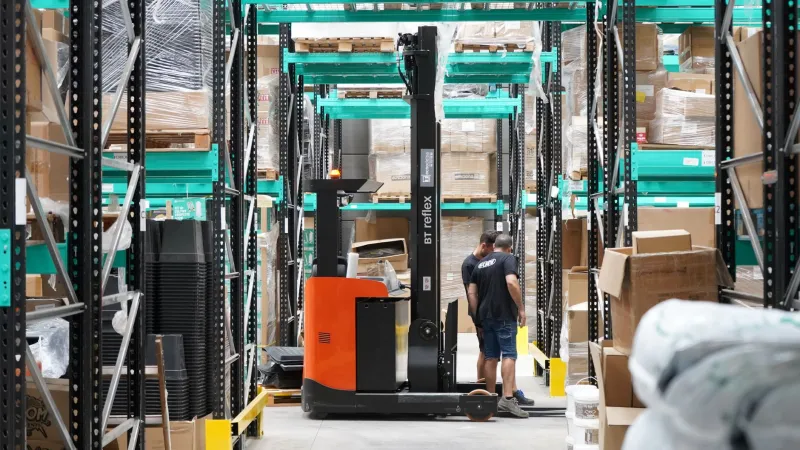
Photo: Basile Morin, CC BY-SA 4.0, via Wikimedia Commons
It arrives on a Thursday. The order was for a named brand; the pallet carries a different one, with a delivery note annotated 'equivalent'. The merchant's system shows the line as fulfilled, the lads want to get on, and there is a client walk-round on Monday. In that moment, accepting the swap feels like the practical choice.
Sometimes it is. Quite often it is not, and the cost of finding out lands months later on your workmanship, your warranty position or your insurance. Brand substitution is not inherently dishonest — supply chains consolidate, own-brand ranges exist, factories produce for several labels from the same line. The problem is that 'equivalent' is a claim made by a supplier, while conformity is an obligation held by whoever installs the product.
Why swaps happen in the first place
Understanding the motive helps you judge the risk. The usual drivers are a manufacturer consolidation or discontinuation, a distributor moving volume onto an own-brand range with better margin, a stock-out on a fast-moving line, or a lead time that has slipped past the point where the merchant will lose the sale. None of these are sinister. All of them mean the substitution was decided commercially, somewhere upstream, without reference to your specification — which is precisely why it needs checking rather than assuming.
The clause that makes it legal, and the one that does not help you
Most trade account terms carry language along the lines of 'the seller may supply an equivalent product where the specified item is unavailable'. That clause generally protects the supplier's right to perform the contract. It does not certify that the product is fit for your particular application, and it does not transfer the specification risk back to them if you accept the goods.
Read the delivery note before signing. If it says 'equivalent', a signature is an acknowledgement, so make sure it is an informed one.
Four checks before the seal is broken
1. Marking and conformity. Look at the packaging, not the paperwork. Depending on the product category, you are looking for UKCA marking, CE marking, or both — and the position is not uniform. For many product regulations, the UK has continued to recognise CE marking for goods placed on the GB market, while construction products and several other regimes have their own rules and transition arrangements. Do not rely on general assumptions; check the specific regime for the product you are buying, and check that the marking is applied to the item and its packaging as required, not just printed on a despatch note.
2. The technical data that actually governs performance. 'Equivalent' is meaningless until it is quantified. For a sealant, that means movement accommodation, cure time and substrate compatibility. For a fixing, shear and tensile loadings, base material and corrosion class. For a board or a panel, Euroclass reaction-to-fire classification and the declared thermal or acoustic values. For anything electrical, the ingress protection rating and the applicable BS EN standard. Put the two datasheets side by side and compare the numbers that matter to your application — not the marketing bullet points.
3. Batch, date and traceability. Record the batch or date code from the carton. Products with a shelf life — adhesives, sealants, resins, mortars, anything with a cure chemistry — need a date of manufacture that gives you realistic working time on site, not merely an in-date label. If the code cannot be found or does not correspond to the delivery note, that is a stop signal.
4. Certification scope. A certificate number is only useful if it covers this product, this factory and this version of the formulation. Third-party certification and declarations of performance are specific documents; check the reference on the packaging against the certificate itself, and check the revision date. A certificate for a superseded formulation is not cover.
When a substitution is genuinely fine
Be fair about this, because refusing every swap makes you a difficult account and eventually an expensive one. A substitution is normally acceptable where the same factory produces both labels and the declared performance data is identical; where the product is a commodity with a stable, published standard and no design-critical variation; where your client has not specified a brand and the finish is not visually critical; and where availability genuinely protects the programme, with the merchant confirming equivalence in writing and accepting a return if it does not perform.
Where those conditions hold, take the stock, note the substitution on the job file and move on.
When accepting it puts you on the line
Refuse, or escalate, where the product is named in a specification or a contract with a design responsibility attached — most JCT and NEC arrangements will treat a named product as a requirement, and a substitution without instruction is a variation you have taken on your own authority. Refuse where the system is a matched one: adhesives, primers, membranes and sealants are frequently warranted only as a complete system, and mixing manufacturers can void the warranty you are relying on to defend your work. Refuse where the product sits within a higher-risk building project, where product information and the golden thread of records under the Building Safety Act regime must be accurate and traceable. And refuse where the product is going into an application with a safety consequence and the equivalence claim is not backed by data.
If the installation is already underway when you discover the swap, stop, photograph everything, quarantine the remaining stock unopened, and put the supplier on notice in writing the same day. Do not return goods without a returns authorisation number and a confirmed credit — an unaccompanied pallet back at a depot is a dispute you will lose.
Put the agreement in writing, once
The most efficient fix is at account level, not order level. Ask for the substitution clause to be qualified: notification before despatch, technical datasheet supplied in advance, written confirmation of conformity marking and certification, and your right to reject at the supplier's cost where the product is not as described. Add a standing instruction to your account record that named brands are not to be substituted without a telephone call.
Then, per order, a short email is enough: 'Delivery received against PO [number] contains [product] in place of [ordered product]. We are holding it pending your written confirmation that the declared performance data and conformity marking are equivalent for use in [application]. Please confirm by return.'
Nine times out of ten the answer comes back within the hour and the job proceeds. The tenth time is the one that would have cost you the contract.