The Pallet That Will Not Shift: Why Volume Discounts Need a Cash-Flow Test, Not a Price Tag
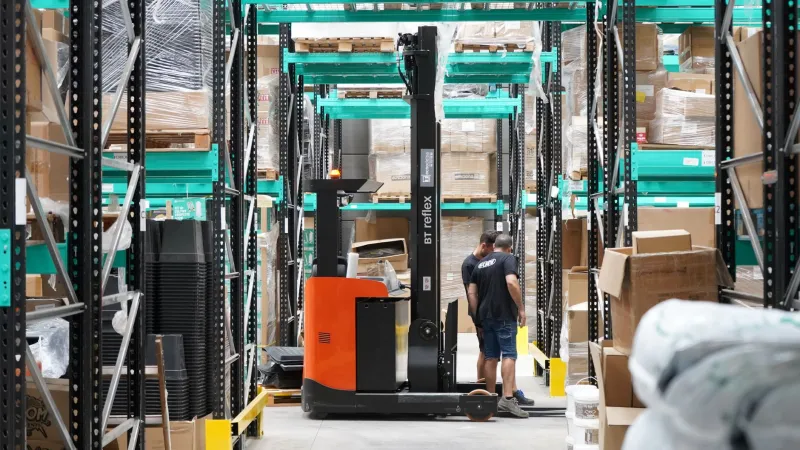
A bulk price break is one of the few honest pleasures of trade buying. The rate per box drops, the pallet price looks sensible, and the purchase order goes out the same afternoon. Six months later the same pallet is still standing there, three-quarters used, occupying racking that could have held something that actually moves — and the invoice was paid so long ago that nobody connects it to the problem anymore.
None of that makes volume buying wrong. It makes it a cash-flow decision that is routinely treated as a pricing decision. The useful question is not 'what is the unit price?' but 'what does this pallet cost me between today and the day the last box leaves the rack?'
The invoice is the first line of the cost, not the total
A landed cost that stops at the invoice tells you almost nothing. For stock held on site, the real per-unit figure has to absorb:
- inbound freight, pallet handling and any tail-lift or timed-delivery premium;
- the footprint itself — racking or floor space you are paying rent and business rates on;
- insurance on stock, which quietly rises with the value you are sitting on;
- shrinkage: damage in handling, split bags, opened boxes, the odd item that walks;
- obsolescence, which is the big one and the one nobody budgets for;
- the cost of the money, whether that is an overdraft, invoice finance or simply cash you cannot spend elsewhere;
- administration — stocktakes, re-counting, moving the same pallet twice a year.
Rolled together, a small trade unit in the UK is usually carrying stock at somewhere between 1.5% and 2.5% of its value per month once rent, insurance, handling and borrowing are counted. Call it 2% for planning purposes and you will not be far out.
The break-even holding period
Once you have that monthly carrying rate, the arithmetic becomes genuinely useful.
Suppose a top-up order of a standard fixing costs you £6.00 a unit, and the full-MOQ price is £4.20. The saving is £1.80 a unit. At a 2% monthly carrying cost, each surplus unit costs roughly 8.4p a month to hold (£4.20 × 2%). Divide the saving by the holding cost: £1.80 ÷ £0.084 gives just over 21 months.
That is your break-even holding period. The bulk price only pays if you will consume the surplus inside roughly 21 months — and that is before you allow for anything going wrong.
Now adjust it for reality. If history says about 8% of a surplus like this never gets used, that is 34p a unit written off the saving, leaving £1.46. If 2% is damaged or lost in handling, knock off another 8p. Effective saving: about £1.38. Divide again: 16 months. That is the number to write on the quotation, not the headline discount.
Three questions before you take the price break
Will I consume the surplus inside the break-even window? If the answer is 'probably', the answer is no. Look at the last twelve months of usage, not the last three.
Does this SKU carry spec risk? Adhesives, sealants and resins have shelf lives and cure-date codes. Tinted or colour-matched products lock you to a batch. Anything a client has named in a specification is a hostage to a design change. Anything on a rolling product cycle — fittings, smart controls, anything with firmware — is a hostage to the calendar.
Can I fund it without borrowing? A discount financed by an overdraft at current rates is often no discount at all. The saving has to beat the cost of the money by a clear margin, or it is a story you are telling yourself.
Where the MOQ usually bites: per line or per order?
Read the price schedule properly. Many suppliers apply a minimum per line, not per order. That distinction is worth thousands on a mixed pallet, because you can often reach the better price tier with a spread of lines rather than a deep single-line commitment. Ask directly: 'is the break on the line quantity or the total order value?' It is a five-second question with an immediate effect on your exposure.
Scripts that actually move a minimum
Suppliers hold MOQs because of pallet economics and internal admin, not because the number is sacred. Work the reasons, not the number.
The trial line. 'We are not a 500-unit account yet, but we would like to be. Can we open at 150 with a written intention to move to the full break on the second order if the fill rate holds?'
The call-off. 'We will commit to the annual volume today if you release it quarterly against scheduled call-offs. You get the forecast, we get the cash flow.'
The part-pallet. 'Will you price a mixed pallet at the volume rate? Same weight, same freight cost to you, three lines instead of one.'
The ladder. 'Send me the price at 100, 250 and 500 and the release schedule you would need for each. We will pick the tier that matches our usage.'
Consignment or sale-or-return on a first order. Less common outside distribution, but worth asking on a new line. A supplier who refuses is telling you something useful about how confident they are in the product.
Splitting an order with another trader
Sharing a pallet with a friendly merchant is a legitimate way to reach a better tier, provided it is documented. Put in writing: who places the order, who is the customer of record, the delivery address and split, who pays the freight, and how the balance is settled if one party's allocation is short.
The detail that catches people out is the warranty. In practice, warranty support follows the invoice. If your name is not on it, your claim is being made by somebody else, and that is a weak position on a site with a problem. Where the value justifies it, ask for separate invoices against one delivery — most suppliers will do it.
What to put on the purchase file
Note the break-even holding period next to the agreed price, and the date the surplus becomes a liability rather than an asset. That single line turns a vague sense of unease about slow stock into a maintenance schedule, which is exactly what stock planning is. The price break is welcome. It is just not the whole story, and it never was.